A meta-song is self-referential. A fine example of a meta-song is found in "Hallelujah" by Leonard Cohen.
Click on the sinusoid to hear. The lyrics in the melody refer to the chords as they are played.
The 'Fourth' and the 'Fifth' refer to chord degrees. There are seven chords in a classic major & minor scale.
"Hallelujah" begins on the C ( I ), then goes to the F ( IV ), the G ( V ). The A Minor VI, and the F major IV.
The singer of the song attempts to serenade his lover, who doesn't "really care for music", with a description of the chords he's playing. According to Cohen, girls adore the finger-picking, but they like chord degrees even more.
Now let's take a look at "Hallelujah" on the oscilloscope.
1 2 3 4 * 5
Wow, look at that! This little waveform reveals much. You can see five major spikes as marked above. These are volume, or amplitude spikes. The five spikes denote the five verses & choruses of this song. The inbetweens are when Buckley is just playing guitar. Right before the first verse is the quietest moment (*) of the song. Listen to Jeff Buckley's Hallelujah
Buckley Breath with Guitar Slap
I heard there was a secret chord, that David played, and it pleased the Lord. Hail Jah!
Every single musical tone is a chord that contains a scale. The secret scale inside every tone is called the Harmonic Series.
The Harmonic Series begins with the Fundamental, in this case the C. This is the tone that you hear as pitch. If you strike this tone on a piano, the rest of the tones in the Series will sound. These harmonics color the timbre of an instrument. They let you know it is a piano that is sounding.
The first harmonic is a higher C, the octave. The second harmonic is a G, the fifth, followed by another octave C. The fourth harmonic is the Major/Minor Third E.
Together, C, E and G form a C Major chord.
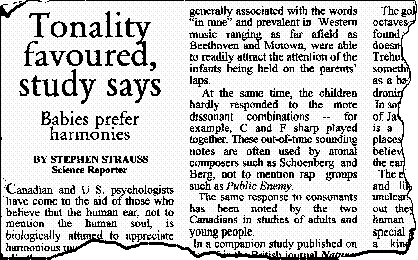
Thus, there is a natural basis to tonality. Scales and Chords came pre-packaged inside every Tone. So it's no wonder why babies prefer Major keys.
The Harmonic Series is also know as the Lydian Dominant scale. It is an obscure key. I can't think of one sing-song that uses it.
However, Alexander Scriabin, the Russian tone poet, uses this scale extensively in his Poem of Fire. Below is Scriabin's favorite chord, The Mystic Chord, which is created from the Lydian Dominant scale.
Thus Spake Zarathrusta by Richard Strauss reveals the origins of music in the harmonic series. The song begins with the Fundamental, C, and adds the other harmonics - the Fifth, Octave, and Thirds.
Well that's it for this Bloggy! Here's what we learned today:
1) Every tone is a chord that contains a scale. 2) This scale is called the Harmonic Series, or Lydian Dominant. 3) The Series shows there is a natural basis to pop tonalities. 4) Thus, babies prefer Major keys. 5) Scriabin was obsessed with Lydian Dominant. 6) Richard Strauss is awesome and babies love him.
"Wooh Hooh" is a non-lexical vocable, or an "utterance without meaning", though the meaning is quite clear in the example below.
Non-lexical vocables express the pure joy of playing and singing music. Fa la la la la. Ob-la-di Ob-la-da.
Backwards, these notes form a D Major Pentatonic Scale. The vocable from Weezer's Dreamin' is also found in an older song.
In both examples, the Wooh Hooh's are sung in falsetto, as Wooh Hooh's ought to be.
Weezer frontman, Rivers Cuomo, carries around a three-ring binder known as "The Enyclopedia of Pop" which breaks down the song formulas of Nirvana, Green Day, and Oasis. (I'd sub in The Beatles for those last two.)
It seems likely that Dreamin' was inspired by You are the Woman, at least unconsciously. There are 3 main reasons why come I believe this:
1) They both go "Wooh hooh whoa oh oh" . 2) They have the same chord progressions. 3) And for Jupiter's sake, they're both in D Major!
Imagine if Music Publications actually reviewed songs? Actually talked about real music? Here's what it'd look like:
Dreamin' by Weezer Keys: D Major and G Major Chords: I III IV V Feel: 4/4 Swing. 4/4 Straight. Tempo: 130 for beginning and end. 90 at the bridge.
You are the Woman by Firefall Keys: D Major Chords: I III II V Feel: 4/4 Straight. Tempo: 120
In You are the Woman, the third chord is an E Minor instead of a G, but the movement in both songs is essentially the same.
A Song Schema, like the ones above, can reveal so much more about the music than buzzy adjectives can.
So here's my music review, fortified with real music talk.
Dreamin' by Weezer is a sick song. The melodies are belt-outs. The music is swinging and straight, yet rocks throughout. The structure is adventerous, featuring a bridge section with a little song within the song, sung by Brian Bell with Rivers Cuomo doing counterpoint. The attitude, as always, is bravura, musical bravado.
Dreamin' harkens to some of the best moments from Pinkerton. The tempo slowdown at the final chorus is reminiscient of Pink Triangle and the chord progression was used in Why Bother and Across the Sea.
The kiss-the-sky feedback in the intro is like the drowsy hypnogogic state preceding the kick-in of dreams.
How can one not like this song? It's 4/4 D major anthemic punk-pop with a swing and child-like lyrics and it's got crazy changes.
Weezer Rules. Wooh Hooh.
Dedicated to all the Post-Green haters. Whoa oh oh.

 Everything on this site is drag-overable, but sometimes you have to click on a widget to activate it. Enjoy!
